

Cash Flow Forecasting for Growing Businesses: How to See a Cash Shortage Before It Happens
Growth can create one of the most dangerous situations in business: increasing sales while cash becomes increasingly difficult to manage.
Revenue may be climbing. The income statement may show a profit. New customers may be coming in.
Yet the owner still finds themselves wondering:
Why does it always feel like we are short on cash?
The answer is often not profitability. It is visibility.
A good cash flow forecast helps management understand not simply how much cash the business has today, but what is likely to happen to that cash over the coming weeks and months.
And that can completely change the way a growing company makes decisions.
Profit Does Not Tell You When Cash Will Arrive
One of the most important distinctions in financial management is the difference between profit and cash flow.
A company can record revenue today and collect the cash weeks or months later. It can purchase inventory before making a sale. It can hire employees months before the additional revenue needed to support those employees arrives.
That creates timing differences between when a company earns money and when cash actually moves through the business.
This is why a profitable business can still experience serious cash flow pressure.
As a company grows, these timing differences frequently become larger rather than smaller.
What Is a Cash Flow Forecast?
A cash flow forecast estimates the cash expected to enter and leave the business over a future period.
At its simplest, the calculation is:
Beginning Cash
- Expected Cash Receipts
– Expected Cash Payments
= Ending Cash
But an effective forecast goes much deeper.
It should incorporate the actual timing of customer collections, payroll, vendor payments, debt payments, taxes, capital expenditures and other significant cash movements.
The objective isn’t to predict the future perfectly.
It is to identify potential problems early enough that management still has options.
Why 13-Week Cash Flow Forecasting Is So Useful
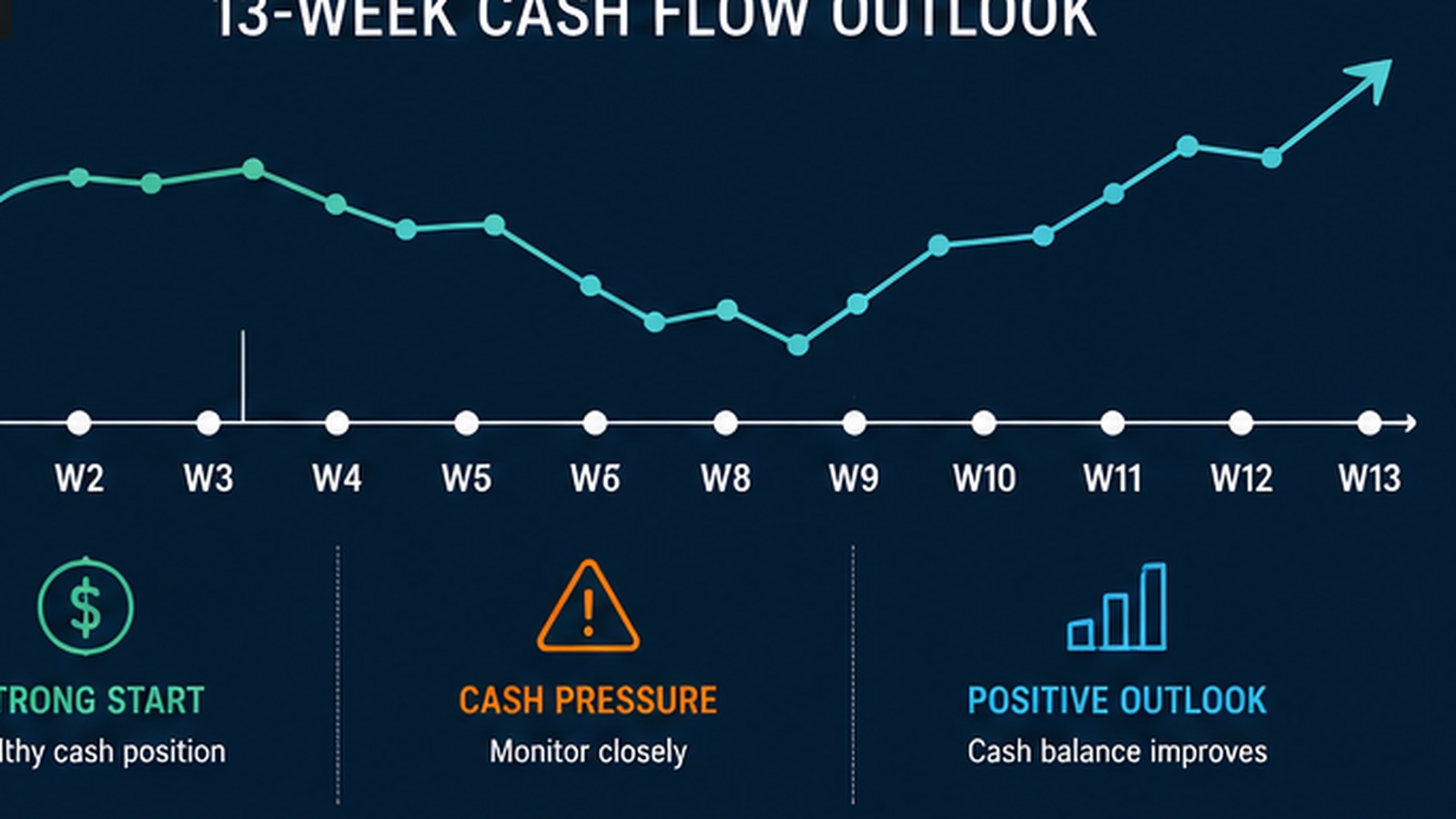
For many businesses, a rolling 13-week cash flow forecast provides an especially useful management tool.
Thirteen weeks is long enough to expose developing cash problems while remaining short enough to forecast with reasonable accuracy.
Each week, the forecast rolls forward another week.
Management can see:
- Expected customer collections
- Payroll requirements
- Vendor payments
- Tax obligations
- Debt service
- Capital expenditures
- Large or unusual cash requirements
- Projected weekly cash balances
Instead of discovering a cash shortage when the bank balance gets uncomfortable, management may see it six, eight or ten weeks beforehand.
That time is valuable.
A Forecast Gives Management Time to Act
Suppose a company’s forecast shows cash falling below its desired minimum eight weeks from now.
Without a forecast, the owner may not recognize the problem until week seven.
At that point, the choices are limited.
But eight weeks of warning creates alternatives.
The company might accelerate collections, negotiate vendor terms, postpone a capital expenditure, adjust inventory purchases, modify hiring plans or arrange financing before it becomes urgent.
That illustrates a broader principle:
Cash Flow Forecasting Becomes More Important as a Business Grows
Smaller businesses can sometimes manage cash by watching the bank account and relying on the owner’s knowledge of upcoming expenses.
Eventually that stops working.
Growth introduces more moving parts:
- More employees
- More customers
- Larger payrolls
- More inventory
- Multiple locations
- Longer receivable cycles
- Larger vendor commitments
- Debt
- Capital investments
- Taxes
- Greater operating complexity
At that point, managing cash based primarily on the current bank balance becomes increasingly risky.
The Forecast Should Connect to the Rest of the Business
A useful cash forecast should not exist in isolation.
Sales forecasts affect collections.
Hiring plans affect payroll.
Inventory decisions affect purchasing.
Capital expenditures affect cash requirements.
Financing decisions affect debt service.
This is where forecasting becomes more than an accounting exercise.
A strong financial process connects operating decisions to their future financial consequences.
For example, management shouldn’t simply ask:
“Can we afford to hire five people?”
The better question is:
“What happens to cash over the next six months if we hire five people now?”
That is a fundamentally different way of making decisions.
Scenario Planning Makes the Forecast More Powerful
No forecast will unfold exactly as expected.
That doesn’t make forecasting less useful. It makes scenario planning more important.
Management can model several possibilities:
Base case: What we currently expect to happen.
Downside case: What happens if sales slow, customers pay later or margins decline?
Upside case: What happens if growth exceeds expectations and requires additional inventory, employees or working capital?
This allows management to understand the financial consequences of uncertainty before committing to a decision.
Cash Flow Forecasting Is Not Just for Businesses in Trouble
There is a common misconception that cash forecasting becomes necessary when a company starts running short of money.
It should happen much earlier.
Companies with strong cash positions can use forecasting to determine:
- How much cash should remain in the business
- Whether expansion can be funded internally
- When additional financing might be required
- Whether excess cash can safely be distributed
- How aggressively the company can hire
- Whether a major investment is financially practical
In other words, cash forecasting isn’t simply a defensive tool.
It is a capital allocation tool.
From Accounting Information to Financial Strategy
Accounting tells you what happened.
Financial leadership should help you understand what is likely to happen next and what management should do about it.
That distinction becomes increasingly important as a company grows.
The goal isn’t to create another spreadsheet.
The goal is to give management enough financial visibility to make decisions with confidence before cash becomes the constraint.
[…] This happens because growth often consumes cash faster than businesses expect. In many cases, fast-growing companies experience more financial stress than companies with flat revenue. Revenue growth can create cash pressure long before a business becomes unprofitable. A forward-looking cash flow forecast can help identify those shortages before they reach the bank ac… […]
[…] Financial planning helps businesses grow intentionally instead of reactively. Measuring the financial impact of better decision-making is one of the clearest ways to evaluate CFO-level leadership. How to Measure the ROI of a Fractional CFO outlines the metrics business owners should track. For growing businesses, cash flow forecasting can reveal future liquidity problems weeks or months before they become urgent… […]
[…] A fractional CFO improves cash flow management by introducing structured forecasting and scenario planning. Leadership teams gain visibility into upcoming financial pressures before they become urgent problems. A strong cash flow forecast gives growing businesses visibility into when a cash shortage may occur … […]